Showing posts with label school life. Show all posts

Sunday, November 3, 2013

昆蟲和植物撞名

為什麼植物學家和昆蟲學家不事先溝通講好?
教授說因為植物和動物的分類是不同的系統,可是分類學家不是應該讓人們(或至少生物學家)方便、清楚,避免重複嗎?

Anisoptera是

也是

Cecropia是
 
也是

Monday, October 28, 2013

紫色洋金花


今天我穿著我的紫色洋金花(Datura metel)的萬聖節裝扮上了一整天的課。念過植物學的人看得出來我是某種茄科植物。有些人猜錯,以為我是牽牛花(這個是另外一科的)。

Ethnobotany的老師愛死我的裝扮了。她猜是Brugmansia(木曼陀羅),我說不是,但非常接近了!經我一番提示,Brugmansia花往下開,什麼往上開?她終於猜對了。

植物分類學教授一看到我就說,"You are a Datura." 呵,薑還是老的辣!不過聽說今年只有兩個學生(包括我)萬聖節裝扮成植物,大家怎麼這麼不給教授面子?

Tuesday, October 8, 2013

Crayfish

My ecology class went on a field trip to sample invertebrates in Otter Creek. It was tons of fun! I got too excited with all the insect nymphs and larvae that we caught under the rocks. There were also many crayfish. It was my first time capturing crayfish with hands. I found they don't really pinch. It might be because the crayfish we caught were not very big.

The other species we found include mayfly, stonefly, caddisfly, dobsonfly, snail, and midges; they indicate that Otter Creek has good water. Well, too bad that we had to release them afterwards so I didn't have crayfish for dinner. I didn't have the chance to take a picture, so here's a picture from the Internet to show you what a crayfish looks like.


Saturday, September 28, 2013

剛開始看怪異,看久了可愛的龍膽

上次在植物園的戶外教學,我看到一些長著怪異紫色花苞的植物,問TA,TA說不知道是什麼。(照片不是我拍的)


回家查資料發現是龍膽的一種,bottle gentian (Gentiana andrewii),紫色的是花,不只是花苞。Wisconsin有紫的和白的近似種,紫的較常見,兩種還會雜交。我們很幸運地遇到它的開花期(8-10月)。緊閉的花瓣其實是植物的詭計,因為蜜蜂必須擠進去取花蜜,難免弄得滿身花粉!


Saturday, June 8, 2013

My First Scholarship

Me at the Undergraduate Award Ceremony (May 9, 2013) receiving my Hilldale Award (the first scholarship in my life), with the chancellor, Mr. David Ward. I received the scholarship for my research project on the Manduca juvenile hormone binding protein.


Me and my two friends from the Department of Entomology.

Saturday, June 1, 2013

The Two Assumptions of Heritability Studies

Evolution cannot occur without at least some traits being heritable. Heritability is a measure of parent-offspring resemblance; so a trait with high heritability has a high genetic component to it, right?
No.

This is one strange and paradoxical thing about heredity studies: heritability is defined as something specific to a certain population in certain circumstances. It is neither a property of an individual nor a property of a trait.

In parent-offspring correlation studies, heritability is simply the slope that measures the resemblance between the average trait value of the two parents and the trait value of the offspring. In twin studies, heritability is the correlation between the trait values of the twins.

From my reading about scientific and philosophical articles on heritability, I figured that two assumptions are implied in those studies without even being mentioned:
(1) Parents and offspring always resemble, instead of differ from, each other. (In other word, the slope of heritability on the parent-offspring graph is always positive.)
(2) Heritability can never equal to zero. This is because of how the math works out. Heritability is a correlation: a covariance over the product of two standard deviations. Covariances and standard deviations are always positive numbers.

Think about it: pick any measurable trait, its heritability will be a non-zero positive number, even if in reality it does not have genetic component. So what does heritability really tell us?

What would our evolution looks like if parents and offspring always tend to differ, not resemble, each other? Would we evolve backwards? Within one generation, the evolutionary response in the offspring will shift in the opposite direction as the selective pressure; however, the response will be cancelled in the grand-offspring generation under the same selective pressure. Just thinking about this weird scenario gave me a giggle fit in my philosophy-biology class.

Tuesday, May 21, 2013

Dumpling Making (Chinese New Year)

I posted those photos on Facebook, but they could only be seemed by group members so I'm posting them here so other people can see them. Those are not all the photos, though.


February 16, 2013: Chinese New Year celebration - dumpling making with oSTEM
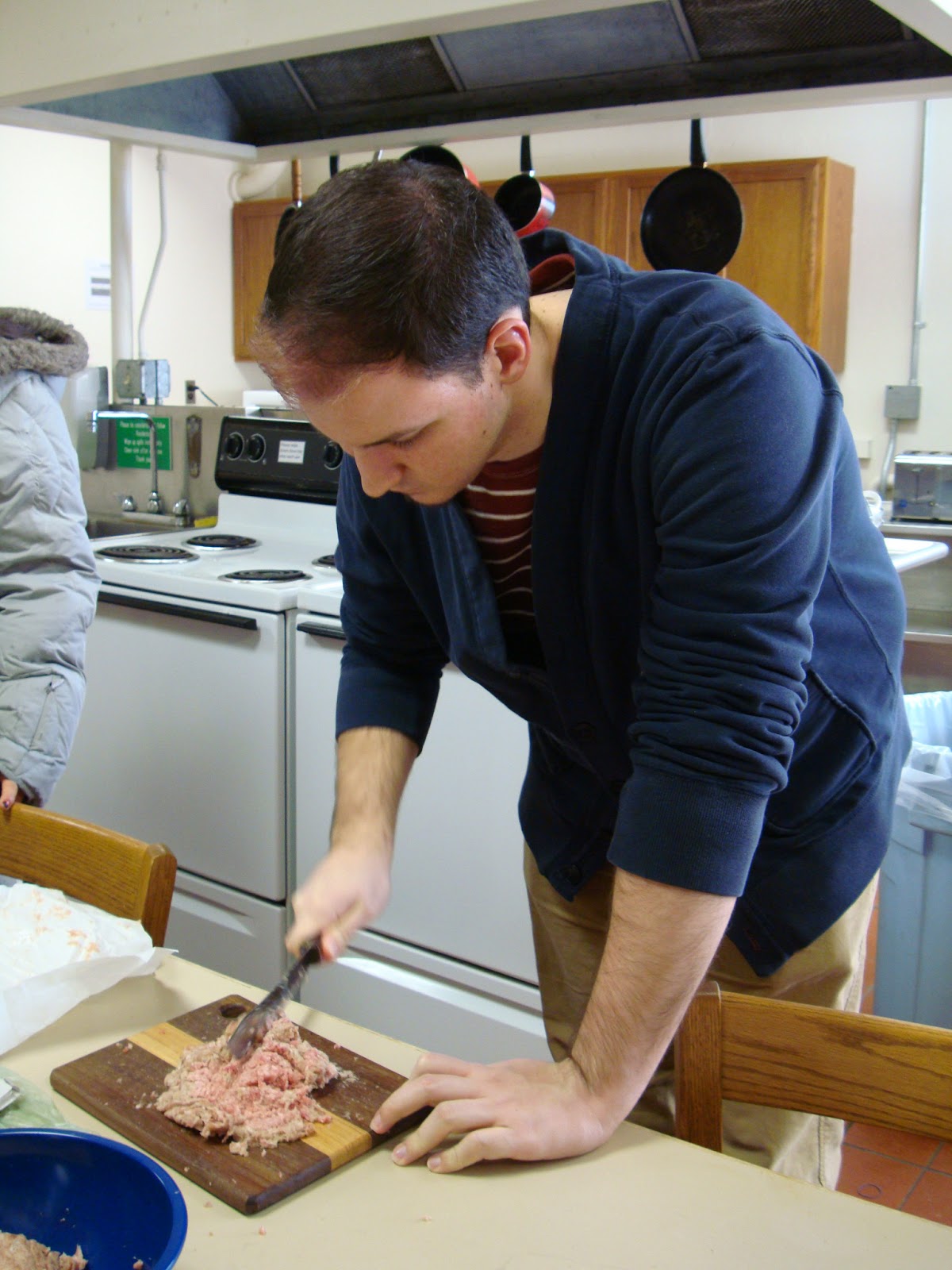
It took a long time just to cut the pork and the cabbage.
We enjoyed it. One of the girls said, there is not a thing we added in the dumpling that I don't like.
I was so prepared in my Chinese shirt. I was teaching ancient Chinese secret! LOL
I think he really had fun chopping the pork.
Good arm exercise. :D
Why that expression? LOL
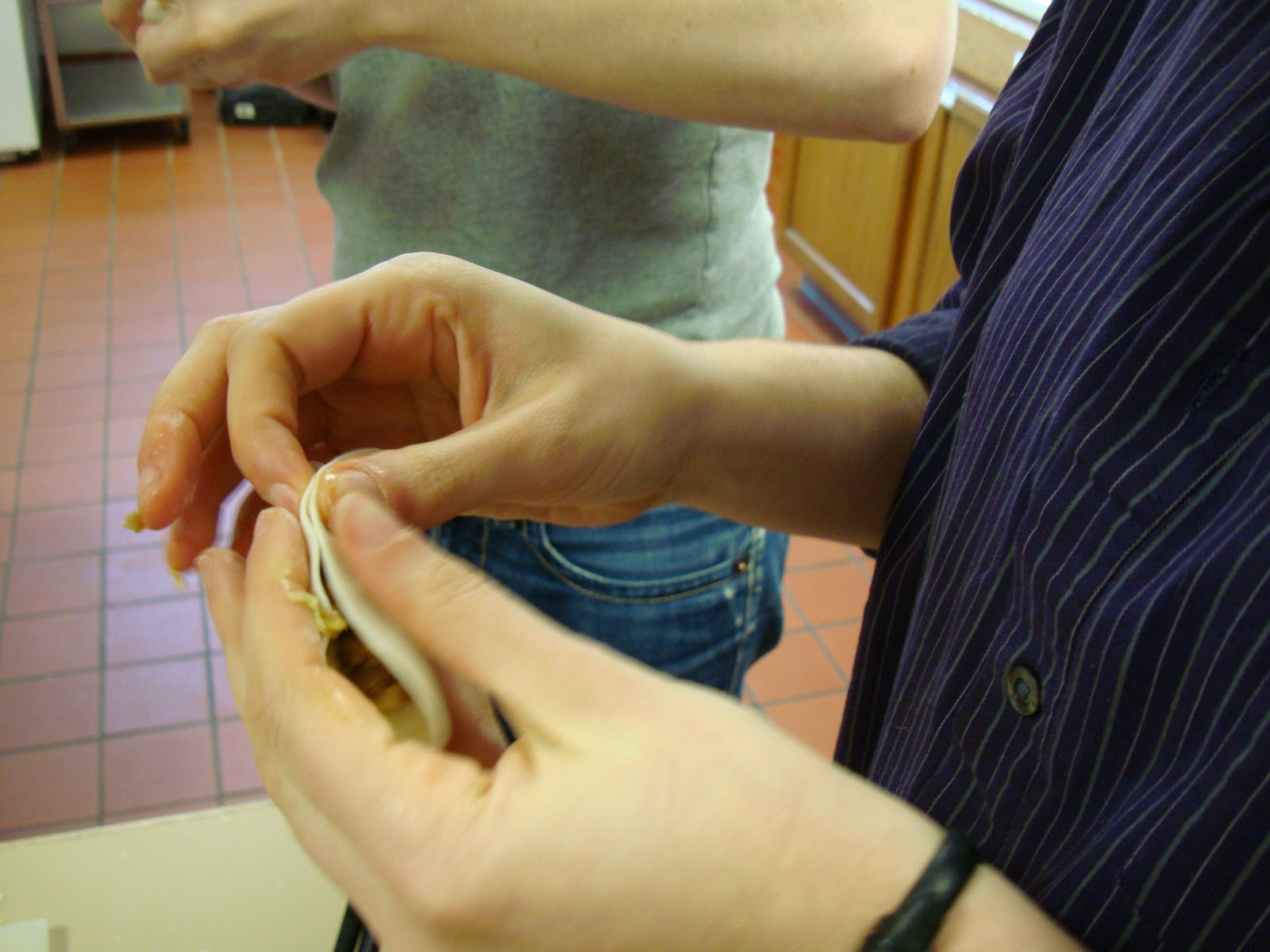
My friends were amazing. We made about a hundred dumplings. It was their first time making dumplings, they learned it by just watching me once, and none of the dumplings broke after boiling.
"My mind just had a little imploding (when I saw how a dumpling is folded)," he said.
It was so delicious! I was so happy and proud! :D
I let them try different sauces. I had soy sauce, white vinegar, sesame oil, chili oil, and spicy bean sauce. They love it, even the spicy bean sauce. It must be a very different taste to them.
She was vegetarian, so she made a batch of vegetarian dumplings.
I think dumpling making is a great New Year tradition to carry on, isn't it?


Thursday, April 4, 2013

Interview at Madison Children's Museum

The manager of the Rooftop of Madison Children's Museum interviewed me. She liked the fact that I love insects and I come from Taiwan. Interested in ethnobotany and indigenous agriculture, she hoped to hear about what vegetables and herbs Taiwanese people grow and eat. She also hoped that I could help take care of their cockroaches and meal-worms, and start a cricket culture; so the animals living on Rooftop will have food source, and children can look at those insects. I think it meant that she gladly accepted me as the summer volunteer, so I'll be going to Children's Museum one morning 9 to 1 o'clock per week to help take care of their garden, animals, and play with children!

Growing Food and Sustainability, after reviewing my application for their summer paid internship, said they were impressed by my application and wanted to interview me soon. I hope the interview will go well. I think one of the greatest things university taught me is bettering my BS ability. I wrote so much for the application but I already forgot what I wrote!

Thursday, March 14, 2013

Newspaper Banned My Comic and Audience's Reaction

After publishing two of my comic stripes, the Daily Cardinal, a student-run newspaper, made a sudden decision that they could not publish Molecules I Have Known and Loved. The release of MIHKAL ended without receiving reader complaints or objection. Several people expressed their disappointment or anger after hearing my apology that MIHKAL was banned.

The Daily Cardinal staff said they were very concerned about depicting dangerous drugs, such as Speed, as cartoon characters. I was very excited to see my works published, but I understand that not all people can tolerate drug-related topics. My comical depiction can be easily interpreted by some people as advocacy for drugs. Here I'm saying again that the intention of my comic is neither promoting nor against recreational drugs. I'm more frustrated with the editors' inconsistency - granting me the opportunity then taking it away within a month.

Professor W. noted that there is always phobia of drugs in the society. He saw the outcome as discouraging but understandable. My lab professor did not see a good potential in MIHKAL as a comic series, but said it surprised him that the Daily Cardinal, well-known on campus for their liberal and undaunting attitude, turned it away.

Other people deemed the newspaper editors' decision as narrow-minded. They understood that MIHKAL is meant to be a humorous take-on of the subject. My current classmate S. K. thought newspapers should publish controversial materials to promote the diversity and freedom of expression. A post doc in philosophy and a physics faculty said it was "ridiculous", because Speed whom was blamed is just a comic character. People who do drugs would have done them anyways, regardless if they read my comic. The faculty said with disbelief that the Daily Cardinal, which publishes offensive and controversial things all the time, including articles that teach people how to have sex, would reject such funny and artistic work.

Some faculties felt sorry for losing an opportunity to educate the public. C. D., a research fellow  specialized in sedative-hypnotics, wrote in a message that "they clearly did not get the scope of [the] comic" and that people just can't make rational judgement on certain topics. The physics faculty imagined MIHKAL would be very informative, which could potentially help reduce drug-related problems in the society. "The problem is we don't talk about it," she said.

A few people thought the newspaper should never publish such material. Perhaps with some misunderstanding, Professor G. said, not unhappily, "[The comic] suggests that you [the author] took and enjoyed those drugs. I was surprised that the newspaper agreed to publish it."

Despite people's divergent opinions, they agreed that the quality of my art is good. I've got a feeling that this is not the end of this incident. The Daily Cardinal staff said they still hoped my art to be a part of their paper and wanted to discuss with me, though with hesitation and possibly denial. Two of my friends eagerly wanted to see MIHKAL published on paper and volunteered to show my online samples to the city-based newspaper office.

So far I'm happy with just doing a web-based comic series and sharing it with my dear friends and professors. It should be a work enjoyed by people who do drugs as well as people who don't. In fact, I've received positive responses from both kinds of people. I'm also getting prepared to be notorious if I'm determined to deal with this subject in long-term. This is definitely not the end of MIHKAL. It just got started.

Monday, February 11, 2013

Standardization of production and purification of Manduca hemolymph JHBP (Abstract)

The abstract of my research project for applying the Hilldale award (my project hasn't have a result and conclusion). Many students have attempted on this project and didn't work out a desirable yield of rJHBP. If my future work is anything useful, the results will contribute to the scientific community. It's kind of hard to believe I'm doing it.

The hemolymph juvenile hormone binding protein (hJHBP) is a specific Lepidopteran protein that binds and transports juvenile hormone (JH). JH plays a number of crucial roles in the regulation of insect development and reproduction. This project will employ a transformed E. coli cell line to express recombinant JHBP (rJHBP). Immunological analysis, cell preparation, and protein purification will be explored to produce and purify rJHBP of optimal quantity and quality. Binding studies will confirm the functionality of rJHBP. The results will provide a stable supply of JHBP for future studies on the binding and target cell docking mechanisms and contribute to increasing our knowledge of insect physiology and pest control.

Friday, February 8, 2013

History Professor

Just thought of how long I haven't been doodling in class. My history of science professor.

好幸福之火腿蛋炒飯

這禮拜每天睡眠不足,上統計學課一直打瞌睡。我想可能是拿到$3000的獎學金的希望讓我撐著,哈!
在Facebook上看到以前的一個高中同學居然晚餐吃電鍋蒸一整顆花菜加三粒魚丸和白飯加鹽;據她本人說不是人吃的。回家做了高麗菜火腿蛋炒飯,把冰箱裡放了一星期快凍成冰米磚的飯用掉,果然飯(美國米比較乾)炒一炒又復活了。一邊吃著這道簡單的家常菜一邊覺得自己好幸福。
今天在廁所撿到某人遺失的學生證和駕照。在用iPad通信的幫助之下,兩小時內順利將證件交還給主人。我想她一定很著急,幫助同學找回遺失的東西感覺真好。
話說學校報社的漫畫版編輯姓Moriarty,每次他寄信來,寄件者都是Moriarty。雖然前面的名字不一樣,我每次看到還是很想笑。

Friday, February 1, 2013

Student Organizations

I'm excited! There are some student organizations that sound very interesting. Some of them are old; some are new. I'll try my best to see which ones I could continue participating.

Besides continuing going to AHA and oSTEM, there's a new group called electronic music production. The group leader is a DJ and people there are all EDM lovers, who may or may not know how to produce music on a computer. Though the majority are male. I don't know how much time I could actually devote into trying the sound manipulation software, but I go there to make friends (lots of dubstep, house, and trance-lovers), and at least learn about the terminology, so I can understand people's conversation on electronic music production.

There is another group that doesn't have meetings, but the leader will arrange you to pair up with a woman in Kenya. Those women are poor people who are learning sewing as a living and English as the second language. Their English might be good or very elementary. If just writing a letter to a person once every few days or few weeks is helping a poor person with limited resources to learn, that sounds like something I'd love to do.

I visited the International Socialist Organization's meeting today. I was curious, and people there seemed to have some interesting ideas and debates. They were friendly too. I might stop by some time during the semester.

There's a Cheese Club that meets every three weeks. They teach you about cheese varieties and let you taste samples. Sadly it conflicts with my other meetings. Oh and the Cyclist Club. It sounds awesome to ride bike with people around Madison for the sake of exercising and relaxing. I could get to know some other parts of Madison too. Of course, we'll have to wait until the weather gets better.

Monday, January 28, 2013

Crazy Start

It's the second week of school. I already have homework piled up and a bunch of books to read. Isn't that crazy? I slept too less last night, spent the free period between classes to read The Origin of Species, got back home and insisted not to sleep until midnight.

I'm happy with the history of science and philosophy biology classes I chose. Although they require more readings than straight science classes, the content is interesting and the instructors are knowledgeable and friendly. I've got an official reason to read The Origin of Species.

I haven't got exercise so I'm stiff, but I'm so tired that I don't feel anything. I want ice-cream and going to sleep. A paper is due after tomorrow. At least I have ice-cream now.

(Surprisingly, it has been raining heavily at night in Madison in the past two days. The snow has melted because of the rain.)

Saturday, December 22, 2012

Wonderful Ending

There was a blizzard on Thursday. The school was closed and all the exams on the day were cancelled. I went out to taste the first big snow of the year and spent half of the evening chatting with Johnny.

Got a hug from my evolutionary biology professor. I finished exams, got straight A for this semester, and rewarded myself with a cup of frozen yogurt. Waiting to go back home. Wonderful ending of my junior fall semester. Can't ask for more!

Friday, November 30, 2012

Perfect Score for Physics

I studied extra hard again for physics and got 100% on this week's midterm! This exam was about rotational motion, harmonic motion, energy conservation, and wave. The calculation was relatively straightforward so many people got 100%. The standard deviation was higher, however, and gave a mean score of 70%.

I could do good in biology and chemistry. Now that I could say basic physics isn't a problem for me either, as long as I have good instruction and work hard. But don't expect me to be obsessed with math and really want to go deeper in physics ... because the next step will involve calculus!

I'm very tired today and planning to go to sleep before 11 PM. I'm going to meet Lynda Barry, an American cartoonist and author, on Saturday. She's going to teach people to draw. I've never read her comic but hopefully the meeting will be interesting!

Caterpillar Fighting

Once the graduate student in my lab told me that they have to separate the Manduca caterpillars into cups as they grow bigger, because they would fight each other to death for food if the place is too crowded. I just couldn't imagine such soft-bodied, harmless-looking creatures could be so aggressive. This week, I saw many small caterpillars in one box banging their upper bodies against each other. Some of them struggled intensely. I even saw a hornworm's little tail fell off because of the fighting. They might well be siblings so what a sibling competition. Wow! Never underestimate the aggressiveness of fragile-looking organisms.

Wednesday, November 28, 2012

電腦螢幕徹底地壞了

雖然我正在用我的舊電腦打字,但是它的螢幕真的壞掉了。不但白點擴大到1/3個螢幕,黑點變大了,其他部分充滿了雜訊,顏色也整個跑掉,幾乎看不清楚東西了,看久了應該很傷眼睛。
我的感覺是只有螢幕壞了,其他部分還是好的。我和學校圖書館借了一台MacBook,一個學生可以一次借三天,一個學期只能借20次,應該還夠我撐到聖誕節。唉,真是的,東西又壞了。

Monday, November 26, 2012

Because Prof. Goodman wasn't there on Saturday ...

Because Prof. Goodman wasn't in the lab on Saturday, I stole 3 liters of double-distilled water home to cook Pu-erh tea and tasted LB medium. When I complained that the Pu-erh tea I cooked tasted awful, Mom suggested me to change the water, because water in Wisconsin is too hard. Double-distilled water did improve the taste significantly! LB medium tasted weird, but not as bad as I thought. It's a bit salty and tasted like protein. I could imagine that bacteria love it.
The E. coli plate I spread by myself; grown after 24 hours.
A shaker-incubator. Prof. Goodman said bacteria need to be shaken all the time to get enough oxygen. Why they no get dizzy?
I set up a schedule to pick up 6 liquid cultures that would have been induced for different times. Unfortunately, this shaker machine broke (because it was too old and some rubber in it broke) when I was collecting the 12-hour culture. I had to start my experiment all over again next time because I couldn't keep the experimental conditions identical for all 6 cultures. I need some luck for my experiment.
I can still use some of the cells for another experiment. I will determine how many fractions we need to collect from the gravity flow column to obtain the most protein tomorrow.

Friday, November 16, 2012

First Successful Dot Blot!

My previous dot blots were failures. If there's something wrong with our method of detecting the JHBP, I can't advance to the extraction process. I tested with hemolymph samples and the results was a weird "negative staining" - the pigment stained the paper, but where the protein is supposed to be remained white. Prof. Goodman said he's never met this problem in his lab. There could be problems with our antibodies, techniques, material, or something else but we didn't know.

Goodman decided that the antibodies in the refrigerator might be expired. We went to the basement on Tuesday to the huge cold room where stores all of his antibodies and other precious stuff. I watched him digging boxes of tubes out of the negative 80 degree Celsius freezer since he hasn't touched them for a long time. Finally he handed me a 50 mL Falcon tube - which reads "MAB #6, 1. 28. 99" - and told me that was the monoclonal mouse anti-JHBP antibody he obtained in 1999.

The process of producing the antibody was expensive and tedious. JHBP was first injected into a mouse and the antibody was produced at peak after a month and half. The mouse's spleen cell was taken out and cultured - a single cell in each well - with spleen cells made cancer. The cells will hybridize successfully in only a few of those cultures, starting to divide indefinitely and producing the primary antibody. This hybrid cancer cell then was injected into the abdominal cavity of another mouse. The poor mouse grew larger and larger with the tumors until it couldn't walk anymore. Its body fluid, a rich source of the antibody, was dripped and collected. Prof. Goodman made a contract with a company that produced this antibody, and he must hand in large quantity of the antigen - the JHBP - in return. However, over a decade he hasn't figured out how to do it.

I was told to separate the antibody into aliquots, because antibody is best not be refrozen. Since Goodman shared his valuable backlog with me, I treated it as deliberately as possible. On the same day, I pipetted the antibody into 108 centrifuge tubes, 100 micro-liter each, and labeled and stored them in the freezer. 

We were suspecting that the problem with the dot blot was the PVDF paper, which didn't seem to absorb the samples, and the dot blot apparatus. Prof. Goodman let me use nitrocellulose paper and just a vacuum instead on Thursday. He killed another Manduca caterpillar for its hemolymph. I prepared the samples, straight hemolymph and 1/10 concentration, and tested them with different concentrations of the primary and secondary antibody.
 
It was a success! Not only we found that nitrocellulose paper absorbs the samples much more efficiently, we also determined the optimal concentrations for each antibody, the ones that stain the samples the darkest while give the lightest background color. It looked like 1:1000 primary antibody and 1:5000 secondary antibody (column #6) is the best combination for detecting JHBP.

A note on the strength of the signal is, I put 2 micro-liter hemolymph on each dot. Goodman said the concentration of JHBP in Manduca hemolymph is 1.4 nano-gram/1 micro-liter. The purple dot we saw there indicated the presence of 2.8 nano-gram of JHBP.

We became much more upbeat, because the problem wasn't the antibodies, which would be a much bigger trouble. Prof. Goodman said this experiment could be my introductory research project. I felt that he looked at me with more appreciation. I'm gradually getting out of the clumsy novice phase. Although it's just start for me, Goodman is also finding that I'm a diligent and capable person - someone he'd like to be in his lab and good for doing science.

P.S.  I asked, "So it means every time I do a Western blot or dot blot, we have to kill a caterpillar?" "That's what they're there for," said Goodman, "We sacrificed trillions of bacteria in the experiments. You can just hear them screaming in the back room 'NO NO NO not me!'" I said, "They're genetically modified to produce a protein that they hate. They probably want to die." "They want to commit bacteriocide!"