Evolution cannot occur without at least some traits being heritable. Heritability is a measure of parent-offspring resemblance; so a trait with high heritability has a high genetic component to it, right?
No.
This is one strange and paradoxical thing about heredity studies: heritability is defined as something specific to a certain population in certain circumstances. It is neither a property of an individual nor a property of a trait.
In parent-offspring correlation studies, heritability is simply the slope that measures the resemblance between the average trait value of the two parents and the trait value of the offspring. In twin studies, heritability is the correlation between the trait values of the twins.
From my reading about scientific and philosophical articles on heritability, I figured that two assumptions are implied in those studies without even being mentioned:
(1) Parents and offspring always resemble, instead of differ from, each other. (In other word, the slope of heritability on the parent-offspring graph is always positive.)
(2) Heritability can never equal to zero. This is because of how the math works out. Heritability is a correlation: a covariance over the product of two standard deviations. Covariances and standard deviations are always positive numbers.
Think about it: pick any measurable trait, its heritability will be a non-zero positive number, even if in reality it does not have genetic component. So what does heritability really tell us?
What would our evolution looks like if parents and offspring always tend to differ, not resemble, each other? Would we evolve backwards? Within one generation, the evolutionary response in the offspring will shift in the opposite direction as the selective pressure; however, the response will be cancelled in the grand-offspring generation under the same selective pressure. Just thinking about this weird scenario gave me a giggle fit in my philosophy-biology class.
Showing posts with label writing. Show all posts
Showing posts with label writing. Show all posts
Saturday, June 1, 2013

Thursday, March 14, 2013
Newspaper Banned My Comic and Audience's Reaction
After publishing two of my comic stripes, the Daily Cardinal, a
student-run newspaper, made a sudden decision that they could not
publish Molecules I Have Known and Loved. The release of MIHKAL
ended without receiving reader complaints or objection. Several people
expressed their disappointment or anger after hearing my apology that
MIHKAL was banned.
The Daily Cardinal staff said they were very concerned about depicting dangerous drugs, such as Speed, as cartoon characters. I was very excited to see my works published, but I understand that not all people can tolerate drug-related topics. My comical depiction can be easily interpreted by some people as advocacy for drugs. Here I'm saying again that the intention of my comic is neither promoting nor against recreational drugs. I'm more frustrated with the editors' inconsistency - granting me the opportunity then taking it away within a month.
Professor W. noted that there is always phobia of drugs in the society. He saw the outcome as discouraging but understandable. My lab professor did not see a good potential in MIHKAL as a comic series, but said it surprised him that the Daily Cardinal, well-known on campus for their liberal and undaunting attitude, turned it away.
Other people deemed the newspaper editors' decision as narrow-minded. They understood that MIHKAL is meant to be a humorous take-on of the subject. My current classmate S. K. thought newspapers should publish controversial materials to promote the diversity and freedom of expression. A post doc in philosophy and a physics faculty said it was "ridiculous", because Speed whom was blamed is just a comic character. People who do drugs would have done them anyways, regardless if they read my comic. The faculty said with disbelief that the Daily Cardinal, which publishes offensive and controversial things all the time, including articles that teach people how to have sex, would reject such funny and artistic work.
Some faculties felt sorry for losing an opportunity to educate the public. C. D., a research fellow specialized in sedative-hypnotics, wrote in a message that "they clearly did not get the scope of [the] comic" and that people just can't make rational judgement on certain topics. The physics faculty imagined MIHKAL would be very informative, which could potentially help reduce drug-related problems in the society. "The problem is we don't talk about it," she said.
A few people thought the newspaper should never publish such material. Perhaps with some misunderstanding, Professor G. said, not unhappily, "[The comic] suggests that you [the author] took and enjoyed those drugs. I was surprised that the newspaper agreed to publish it."
Despite people's divergent opinions, they agreed that the quality of my art is good. I've got a feeling that this is not the end of this incident. The Daily Cardinal staff said they still hoped my art to be a part of their paper and wanted to discuss with me, though with hesitation and possibly denial. Two of my friends eagerly wanted to see MIHKAL published on paper and volunteered to show my online samples to the city-based newspaper office.
So far I'm happy with just doing a web-based comic series and sharing it with my dear friends and professors. It should be a work enjoyed by people who do drugs as well as people who don't. In fact, I've received positive responses from both kinds of people. I'm also getting prepared to be notorious if I'm determined to deal with this subject in long-term. This is definitely not the end of MIHKAL. It just got started.
The Daily Cardinal staff said they were very concerned about depicting dangerous drugs, such as Speed, as cartoon characters. I was very excited to see my works published, but I understand that not all people can tolerate drug-related topics. My comical depiction can be easily interpreted by some people as advocacy for drugs. Here I'm saying again that the intention of my comic is neither promoting nor against recreational drugs. I'm more frustrated with the editors' inconsistency - granting me the opportunity then taking it away within a month.
Professor W. noted that there is always phobia of drugs in the society. He saw the outcome as discouraging but understandable. My lab professor did not see a good potential in MIHKAL as a comic series, but said it surprised him that the Daily Cardinal, well-known on campus for their liberal and undaunting attitude, turned it away.
Other people deemed the newspaper editors' decision as narrow-minded. They understood that MIHKAL is meant to be a humorous take-on of the subject. My current classmate S. K. thought newspapers should publish controversial materials to promote the diversity and freedom of expression. A post doc in philosophy and a physics faculty said it was "ridiculous", because Speed whom was blamed is just a comic character. People who do drugs would have done them anyways, regardless if they read my comic. The faculty said with disbelief that the Daily Cardinal, which publishes offensive and controversial things all the time, including articles that teach people how to have sex, would reject such funny and artistic work.
Some faculties felt sorry for losing an opportunity to educate the public. C. D., a research fellow specialized in sedative-hypnotics, wrote in a message that "they clearly did not get the scope of [the] comic" and that people just can't make rational judgement on certain topics. The physics faculty imagined MIHKAL would be very informative, which could potentially help reduce drug-related problems in the society. "The problem is we don't talk about it," she said.
A few people thought the newspaper should never publish such material. Perhaps with some misunderstanding, Professor G. said, not unhappily, "[The comic] suggests that you [the author] took and enjoyed those drugs. I was surprised that the newspaper agreed to publish it."
Despite people's divergent opinions, they agreed that the quality of my art is good. I've got a feeling that this is not the end of this incident. The Daily Cardinal staff said they still hoped my art to be a part of their paper and wanted to discuss with me, though with hesitation and possibly denial. Two of my friends eagerly wanted to see MIHKAL published on paper and volunteered to show my online samples to the city-based newspaper office.
So far I'm happy with just doing a web-based comic series and sharing it with my dear friends and professors. It should be a work enjoyed by people who do drugs as well as people who don't. In fact, I've received positive responses from both kinds of people. I'm also getting prepared to be notorious if I'm determined to deal with this subject in long-term. This is definitely not the end of MIHKAL. It just got started.
Monday, February 11, 2013
Standardization of production and purification of Manduca hemolymph JHBP (Abstract)
The abstract of my research project for applying the Hilldale award (my project hasn't have a result and conclusion). Many students have attempted on this project and didn't work out a desirable yield of rJHBP. If my future work is anything useful, the results will contribute to the scientific community. It's kind of hard to believe I'm doing it.
The hemolymph juvenile
hormone binding protein (hJHBP) is a specific Lepidopteran protein that binds
and transports juvenile hormone (JH). JH plays a number of crucial roles in the
regulation of insect development and reproduction. This project will employ a
transformed E. coli cell line to
express recombinant JHBP (rJHBP). Immunological analysis, cell preparation, and
protein purification will be explored to produce and purify rJHBP of optimal
quantity and quality. Binding studies will confirm the functionality of rJHBP.
The results will provide a stable supply of JHBP for future studies on the
binding and target cell docking mechanisms and contribute to increasing our
knowledge of insect physiology and pest control.
Tuesday, November 6, 2012
The Third Eye of Lizards and Humans
"The chemicals used for light
perception in the lizard’s third eye are structurally similar to the
psychedelic molecules humans use to open their 'third eye'."
Rita Chen
November 5, 2012
 |
| Seraphic Transport Docking on the Third Eye, 2004, Alex Grey |
“Opening the third eye” is a cliché
slogan and a concept of psychedelic users to describe the extended sight and mental
perception under the influence of psychedelics that are beyond the normal state
of mind. The phrase might be borrowed from Hinduism, in which the third eye is
called ajna chakra and is believed to be positioned in the brain, between the
eyebrows. The third eye, an asymmetrical structure, is usually not seen in
bilaterians. Nevertheless, a news story published in September, 2012 talked
about some species of lizards have a third eye, a little dot on the top of
their heads, called the parietal eye. The chemicals that these lizards use to
perceive light in the third eye are similar to some of the psychedelic drug
molecules, which suggests a connection between the slogan and this ancient body
structure.
 |
| A tuatara. The little dot on the top of its head is the parietal eye, the "third eye" of this species. |
The “lizard species” with the third
eye such as tuatara found in New Zealand are actually not lizards in the
phylogenetic sense. The parietal eye is not as complex as the other two eyes,
but does react to light. Evidence suggests that the structure is present in a
shared ancestry of today’s mammals and reptiles. While some lizard species have
the parietal eye, it is lost in most extant tetrapods. The development of a
third eye is asymmetrical. In those reptiles, the left side of the brain
becomes the parietal eye, while the right side of the brain becomes the pineal
sac, which secretes melatonin that responds to light.
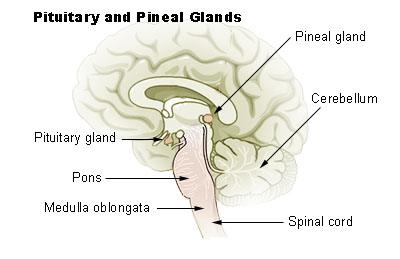 |
| The position of the pineal gland relative to other brain structures in humans. |
In humans, the homology to the
pineal sac is the pineal gland, which stays down with the rest of the brain
instead of situated at the top of the head. The pineal gland also secretes
melatonin, the hormone that regulates biological rhythms. Melatonin is a
derivative of serotonin, the major neurotransmitter responsible for the feeling
of well-being, happiness, and normal sleeping patterns. The pineal gland secretes some serotonin.
The tryptamine psychedelics are
structurally similar to serotonin and melatonin, and act as serotonin agonists
when they enter the brain. Examples of naturally-occurring psychedelic
tryptamines are DMT, 5-MeO-DMT, psilocin, psilocybin, and bufotenin. Except
producing hallucinations, dissociation, and changes in mood and behavior,
psychedelia is often associated with extended perception beyond the normal
sight and spiritual experiences. According to the news story, because the pineal
gland in humans has evolved to maintain a healthy state of mind, instead of
light perception, having a third eye could be “at the expense of being able to
sleep, be happy, and keep mentally fit.” Ironically indeed, while people
attempt using psychedelics to achieve spirituality and see what is beyond the
normal two eyes can see, their time and light perception is severely distorted,
their mood can be affected in positive or negative ways, and even have a small
chance to trigger underlying psychosis. People on psychedelics often see objects
becoming more colorful, lights coming out of nowhere, or glowing objects. Since
time perception is changed, the trip could feel much longer than it is. An
extreme story is that a person feels that he has gone through a life-time
experience in a bizarre, alternate universe during a 15-minute DMT trip.
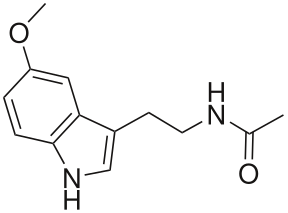 |
| Melatonin (N-acetyl-5-methoxytryptamine), the hormone secreted by the pineal gland to regulate biological rhythm, is a derivative of serotonin. |
 |
| Serotonin (5-hydroxytryptamine), the neurotransmitter responsible for the feeling of well-being, happiness, and normal sleeping patterns. |
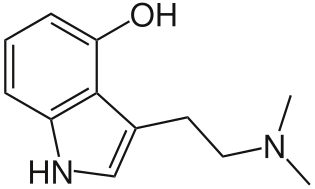 |
| Psilocin (4-hydroxy-dimethyltryptamine), a psychedelic tryptamine that is closely related to serotonin, occurred naturally in many species of mushrooms. |
The chemicals used for light
perception in the lizard’s third eye are structurally similar to the
psychedelic molecules humans use to open their “third eye”. However, the pineal
gland and melatonin have evolved to serve different functions in lizards and
humans. Perhaps, “opening the third eye” is not merely gibberish spoken by
people who are high, or a coincidence between the Indian and the Western interpretation
on an altered state of mind, but a deep, ancient connection between the physiological
structures of related lineages with an evolutionary explanation.
Subscribe to:
Posts (Atom)