Me and my two friends from the Department of Entomology.
Showing posts with label biochemistry. Show all posts
Saturday, June 8, 2013
My First Scholarship
Me at the Undergraduate Award Ceremony (May 9, 2013) receiving my Hilldale Award (the first scholarship in my life), with the chancellor, Mr. David Ward. I received the scholarship for my research project on the Manduca juvenile hormone binding protein.
Monday, February 11, 2013
Standardization of production and purification of Manduca hemolymph JHBP (Abstract)
The abstract of my research project for applying the Hilldale award (my project hasn't have a result and conclusion). Many students have attempted on this project and didn't work out a desirable yield of rJHBP. If my future work is anything useful, the results will contribute to the scientific community. It's kind of hard to believe I'm doing it.
The hemolymph juvenile
hormone binding protein (hJHBP) is a specific Lepidopteran protein that binds
and transports juvenile hormone (JH). JH plays a number of crucial roles in the
regulation of insect development and reproduction. This project will employ a
transformed E. coli cell line to
express recombinant JHBP (rJHBP). Immunological analysis, cell preparation, and
protein purification will be explored to produce and purify rJHBP of optimal
quantity and quality. Binding studies will confirm the functionality of rJHBP.
The results will provide a stable supply of JHBP for future studies on the
binding and target cell docking mechanisms and contribute to increasing our
knowledge of insect physiology and pest control.
Labels:
biochemistry,
biology,
entomology,
lab,
research,
school life,
science,
writing
Monday, November 26, 2012
Because Prof. Goodman wasn't there on Saturday ...
Because Prof. Goodman wasn't in the lab on Saturday, I stole 3 liters of double-distilled water home to cook Pu-erh tea and tasted LB medium. When I complained that the Pu-erh tea I cooked tasted awful, Mom suggested me to change the water, because water in Wisconsin is too hard. Double-distilled water did improve the taste significantly! LB medium tasted weird, but not as bad as I thought. It's a bit salty and tasted like protein. I could imagine that bacteria love it.
I set up a schedule to pick up 6 liquid cultures that would have been induced for different times. Unfortunately, this shaker machine broke (because it was too old and some rubber in it broke) when I was collecting the 12-hour culture. I had to start my experiment all over again next time because I couldn't keep the experimental conditions identical for all 6 cultures. I need some luck for my experiment.
I can still use some of the cells for another experiment. I will determine how many fractions we need to collect from the gravity flow column to obtain the most protein tomorrow.
The E. coli plate I spread by myself; grown after 24 hours.
A shaker-incubator. Prof. Goodman said bacteria need to be shaken all the time to get enough oxygen. Why they no get dizzy?I set up a schedule to pick up 6 liquid cultures that would have been induced for different times. Unfortunately, this shaker machine broke (because it was too old and some rubber in it broke) when I was collecting the 12-hour culture. I had to start my experiment all over again next time because I couldn't keep the experimental conditions identical for all 6 cultures. I need some luck for my experiment.
I can still use some of the cells for another experiment. I will determine how many fractions we need to collect from the gravity flow column to obtain the most protein tomorrow.
Friday, November 16, 2012
First Successful Dot Blot!
My previous dot blots were failures. If there's something wrong with our method of detecting the JHBP, I can't advance to the extraction process. I tested with hemolymph samples and the results was a weird "negative staining" - the pigment stained the paper, but where the protein is supposed to be remained white. Prof. Goodman said he's never met this problem in his lab. There could be problems with our antibodies, techniques, material, or something else but we didn't know.
Goodman decided that the antibodies in the refrigerator might be expired. We went to the basement on Tuesday to the huge cold room where stores all of his antibodies and other precious stuff. I watched him digging boxes of tubes out of the negative 80 degree Celsius freezer since he hasn't touched them for a long time. Finally he handed me a 50 mL Falcon tube - which reads "MAB #6, 1. 28. 99" - and told me that was the monoclonal mouse anti-JHBP antibody he obtained in 1999.
The process of producing the antibody was expensive and tedious. JHBP was first injected into a mouse and the antibody was produced at peak after a month and half. The mouse's spleen cell was taken out and cultured - a single cell in each well - with spleen cells made cancer. The cells will hybridize successfully in only a few of those cultures, starting to divide indefinitely and producing the primary antibody. This hybrid cancer cell then was injected into the abdominal cavity of another mouse. The poor mouse grew larger and larger with the tumors until it couldn't walk anymore. Its body fluid, a rich source of the antibody, was dripped and collected. Prof. Goodman made a contract with a company that produced this antibody, and he must hand in large quantity of the antigen - the JHBP - in return. However, over a decade he hasn't figured out how to do it.
I was told to separate the antibody into aliquots, because antibody is best not be refrozen. Since Goodman shared his valuable backlog with me, I treated it as deliberately as possible. On the same day, I pipetted the antibody into 108 centrifuge tubes, 100 micro-liter each, and labeled and stored them in the freezer.
We were suspecting that the problem with the dot blot was the PVDF paper, which didn't seem to absorb the samples, and the dot blot apparatus. Prof. Goodman let me use nitrocellulose paper and just a vacuum instead on Thursday. He killed another Manduca caterpillar for its hemolymph. I prepared the samples, straight hemolymph and 1/10 concentration, and tested them with different concentrations of the primary and secondary antibody.
It was a success! Not only we found that nitrocellulose paper absorbs the samples much more efficiently, we also determined the optimal concentrations for each antibody, the ones that stain the samples the darkest while give the lightest background color. It looked like 1:1000 primary antibody and 1:5000 secondary antibody (column #6) is the best combination for detecting JHBP.
A note on the strength of the signal is, I put 2 micro-liter hemolymph on each dot. Goodman said the concentration of JHBP in Manduca hemolymph is 1.4 nano-gram/1 micro-liter. The purple dot we saw there indicated the presence of 2.8 nano-gram of JHBP.
We became much more upbeat, because the problem wasn't the antibodies, which would be a much bigger trouble. Prof. Goodman said this experiment could be my introductory research project. I felt that he looked at me with more appreciation. I'm gradually getting out of the clumsy novice phase. Although it's just start for me, Goodman is also finding that I'm a diligent and capable person - someone he'd like to be in his lab and good for doing science.
P.S. I asked, "So it means every time I do a Western blot or dot blot, we have to kill a caterpillar?" "That's what they're there for," said Goodman, "We sacrificed trillions of bacteria in the experiments. You can just hear them screaming in the back room 'NO NO NO not me!'" I said, "They're genetically modified to produce a protein that they hate. They probably want to die." "They want to commit bacteriocide!"
Goodman decided that the antibodies in the refrigerator might be expired. We went to the basement on Tuesday to the huge cold room where stores all of his antibodies and other precious stuff. I watched him digging boxes of tubes out of the negative 80 degree Celsius freezer since he hasn't touched them for a long time. Finally he handed me a 50 mL Falcon tube - which reads "MAB #6, 1. 28. 99" - and told me that was the monoclonal mouse anti-JHBP antibody he obtained in 1999.
The process of producing the antibody was expensive and tedious. JHBP was first injected into a mouse and the antibody was produced at peak after a month and half. The mouse's spleen cell was taken out and cultured - a single cell in each well - with spleen cells made cancer. The cells will hybridize successfully in only a few of those cultures, starting to divide indefinitely and producing the primary antibody. This hybrid cancer cell then was injected into the abdominal cavity of another mouse. The poor mouse grew larger and larger with the tumors until it couldn't walk anymore. Its body fluid, a rich source of the antibody, was dripped and collected. Prof. Goodman made a contract with a company that produced this antibody, and he must hand in large quantity of the antigen - the JHBP - in return. However, over a decade he hasn't figured out how to do it.
I was told to separate the antibody into aliquots, because antibody is best not be refrozen. Since Goodman shared his valuable backlog with me, I treated it as deliberately as possible. On the same day, I pipetted the antibody into 108 centrifuge tubes, 100 micro-liter each, and labeled and stored them in the freezer.
We were suspecting that the problem with the dot blot was the PVDF paper, which didn't seem to absorb the samples, and the dot blot apparatus. Prof. Goodman let me use nitrocellulose paper and just a vacuum instead on Thursday. He killed another Manduca caterpillar for its hemolymph. I prepared the samples, straight hemolymph and 1/10 concentration, and tested them with different concentrations of the primary and secondary antibody.
It was a success! Not only we found that nitrocellulose paper absorbs the samples much more efficiently, we also determined the optimal concentrations for each antibody, the ones that stain the samples the darkest while give the lightest background color. It looked like 1:1000 primary antibody and 1:5000 secondary antibody (column #6) is the best combination for detecting JHBP.
A note on the strength of the signal is, I put 2 micro-liter hemolymph on each dot. Goodman said the concentration of JHBP in Manduca hemolymph is 1.4 nano-gram/1 micro-liter. The purple dot we saw there indicated the presence of 2.8 nano-gram of JHBP.
We became much more upbeat, because the problem wasn't the antibodies, which would be a much bigger trouble. Prof. Goodman said this experiment could be my introductory research project. I felt that he looked at me with more appreciation. I'm gradually getting out of the clumsy novice phase. Although it's just start for me, Goodman is also finding that I'm a diligent and capable person - someone he'd like to be in his lab and good for doing science.
P.S. I asked, "So it means every time I do a Western blot or dot blot, we have to kill a caterpillar?" "That's what they're there for," said Goodman, "We sacrificed trillions of bacteria in the experiments. You can just hear them screaming in the back room 'NO NO NO not me!'" I said, "They're genetically modified to produce a protein that they hate. They probably want to die." "They want to commit bacteriocide!"
Thursday, November 8, 2012
Lab Is Going Slow
I just took the genetics midterm today. Not sure how it'd go, because the material this time is a lot complicated, conceptual, and the professor is a bad lecturer. Like my friend said, he bombards everyone with loads of random information and expects us to know. My classmates are probably on the same boat. I've heard a lot of people dropping their calculators on the floor during the exam. I guess it was because they got too nervous.
The good news is I seem to do better in physics class with time. It was just like when I started learning college chemistry. With no strong previous training, I got very nervous for falling behind my peers. With time and hard work, and the material builds up on itself, I grasp the concepts faster and deeper than many classmates: I tend to, want to seek the meaning behind those mathematic calculations and am able to concentrate. (Well, as long as the math doesn't get more complicated than algebra and trigonometry.) My physics TA gave me a high-five today for solving a hard problem regarding harmonic oscillation on my own.
My lab work is going slow recently, nevertheless. The first dot blot analysis I did showed that my bacteria weren't producing any the protein, JHBP-SUMO. Professor G. and I have spent a lot of time trying to troubleshoot, and I've been even encountering troubles on those troubleshooting experiments. The works of the previous student showed that our bacteria were producing the right protein at some points, but very small amounts, and the bacteria seemed to cleave the protein into half. Professor G. raised an interesting point, which is, the bacteria might dislike this protein product and release it outside of the cells. Our dot blots so far only test samples of lysed bacteria, for we assumed that the protein stayed inside the cells after being synthesized.
My sleeps in the past week have been too short to have dreams, but I probably had a very vague dream that the bacteria indeed spit the protein out, and I find much more JHBP-SUMO in the LB cell medium. I'm getting a little frustrated and I hope things will becoming more clear by the end of this year.
Oh, that's random but, the graduate student of Professor G. told me that insects are incapable of feeling pain; or rather, they don't feel pain the same way vertebrates do. Physical harm for them is but negative stimuli. It's one of the main reasons why there are no protocols of regulating experiments on most invertebrates. This at least makes me feel better when we have to bleed Manduca caterpillars for experiments.
The good news is I seem to do better in physics class with time. It was just like when I started learning college chemistry. With no strong previous training, I got very nervous for falling behind my peers. With time and hard work, and the material builds up on itself, I grasp the concepts faster and deeper than many classmates: I tend to, want to seek the meaning behind those mathematic calculations and am able to concentrate. (Well, as long as the math doesn't get more complicated than algebra and trigonometry.) My physics TA gave me a high-five today for solving a hard problem regarding harmonic oscillation on my own.
My lab work is going slow recently, nevertheless. The first dot blot analysis I did showed that my bacteria weren't producing any the protein, JHBP-SUMO. Professor G. and I have spent a lot of time trying to troubleshoot, and I've been even encountering troubles on those troubleshooting experiments. The works of the previous student showed that our bacteria were producing the right protein at some points, but very small amounts, and the bacteria seemed to cleave the protein into half. Professor G. raised an interesting point, which is, the bacteria might dislike this protein product and release it outside of the cells. Our dot blots so far only test samples of lysed bacteria, for we assumed that the protein stayed inside the cells after being synthesized.
My sleeps in the past week have been too short to have dreams, but I probably had a very vague dream that the bacteria indeed spit the protein out, and I find much more JHBP-SUMO in the LB cell medium. I'm getting a little frustrated and I hope things will becoming more clear by the end of this year.
Oh, that's random but, the graduate student of Professor G. told me that insects are incapable of feeling pain; or rather, they don't feel pain the same way vertebrates do. Physical harm for them is but negative stimuli. It's one of the main reasons why there are no protocols of regulating experiments on most invertebrates. This at least makes me feel better when we have to bleed Manduca caterpillars for experiments.
Labels:
biochemistry,
entomology,
genetics,
lab,
physics,
school life
Tuesday, November 6, 2012
The Third Eye of Lizards and Humans
"The chemicals used for light
perception in the lizard’s third eye are structurally similar to the
psychedelic molecules humans use to open their 'third eye'."
Rita Chen
November 5, 2012
| Seraphic Transport Docking on the Third Eye, 2004, Alex Grey |
“Opening the third eye” is a cliché
slogan and a concept of psychedelic users to describe the extended sight and mental
perception under the influence of psychedelics that are beyond the normal state
of mind. The phrase might be borrowed from Hinduism, in which the third eye is
called ajna chakra and is believed to be positioned in the brain, between the
eyebrows. The third eye, an asymmetrical structure, is usually not seen in
bilaterians. Nevertheless, a news story published in September, 2012 talked
about some species of lizards have a third eye, a little dot on the top of
their heads, called the parietal eye. The chemicals that these lizards use to
perceive light in the third eye are similar to some of the psychedelic drug
molecules, which suggests a connection between the slogan and this ancient body
structure.
![]() |
| A tuatara. The little dot on the top of its head is the parietal eye, the "third eye" of this species. |
The “lizard species” with the third
eye such as tuatara found in New Zealand are actually not lizards in the
phylogenetic sense. The parietal eye is not as complex as the other two eyes,
but does react to light. Evidence suggests that the structure is present in a
shared ancestry of today’s mammals and reptiles. While some lizard species have
the parietal eye, it is lost in most extant tetrapods. The development of a
third eye is asymmetrical. In those reptiles, the left side of the brain
becomes the parietal eye, while the right side of the brain becomes the pineal
sac, which secretes melatonin that responds to light.
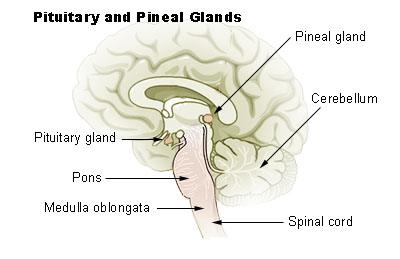
| The position of the pineal gland relative to other brain structures in humans. |
In humans, the homology to the
pineal sac is the pineal gland, which stays down with the rest of the brain
instead of situated at the top of the head. The pineal gland also secretes
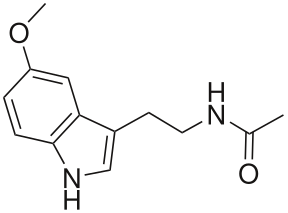
melatonin, the hormone that regulates biological rhythms. Melatonin is a
derivative of serotonin, the major neurotransmitter responsible for the feeling
of well-being, happiness, and normal sleeping patterns. The pineal gland secretes some serotonin.
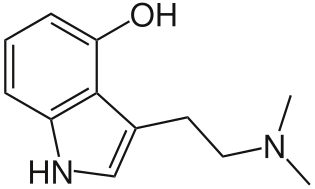
The tryptamine psychedelics are
structurally similar to serotonin and melatonin, and act as serotonin agonists
when they enter the brain. Examples of naturally-occurring psychedelic
tryptamines are DMT, 5-MeO-DMT, psilocin, psilocybin, and bufotenin. Except
producing hallucinations, dissociation, and changes in mood and behavior,
psychedelia is often associated with extended perception beyond the normal
sight and spiritual experiences. According to the news story, because the pineal
gland in humans has evolved to maintain a healthy state of mind, instead of
light perception, having a third eye could be “at the expense of being able to
sleep, be happy, and keep mentally fit.” Ironically indeed, while people
attempt using psychedelics to achieve spirituality and see what is beyond the
normal two eyes can see, their time and light perception is severely distorted,
their mood can be affected in positive or negative ways, and even have a small
chance to trigger underlying psychosis. People on psychedelics often see objects
becoming more colorful, lights coming out of nowhere, or glowing objects. Since
time perception is changed, the trip could feel much longer than it is. An
extreme story is that a person feels that he has gone through a life-time
experience in a bizarre, alternate universe during a 15-minute DMT trip.
| Melatonin (N-acetyl-5-methoxytryptamine), the hormone secreted by the pineal gland to regulate biological rhythm, is a derivative of serotonin. |
| Serotonin (5-hydroxytryptamine), the neurotransmitter responsible for the feeling of well-being, happiness, and normal sleeping patterns. |
| Psilocin (4-hydroxy-dimethyltryptamine), a psychedelic tryptamine that is closely related to serotonin, occurred naturally in many species of mushrooms. |
The chemicals used for light
perception in the lizard’s third eye are structurally similar to the
psychedelic molecules humans use to open their “third eye”. However, the pineal
gland and melatonin have evolved to serve different functions in lizards and
humans. Perhaps, “opening the third eye” is not merely gibberish spoken by
people who are high, or a coincidence between the Indian and the Western interpretation
on an altered state of mind, but a deep, ancient connection between the physiological
structures of related lineages with an evolutionary explanation.
Subscribe to:
Comments (Atom)


.jpg)