上次在植物園的戶外教學,我看到一些長著怪異紫色花苞的植物,問TA,TA說不知道是什麼。(照片不是我拍的)
回家查資料發現是龍膽的一種,bottle gentian (Gentiana andrewii),紫色的是花,不只是花苞。Wisconsin有紫的和白的近似種,紫的較常見,兩種還會雜交。我們很幸運地遇到它的開花期(8-10月)。緊閉的花瓣其實是植物的詭計,因為蜜蜂必須擠進去取花蜜,難免弄得滿身花粉!
Saturday, September 28, 2013
Thursday, September 19, 2013
If I Have a Garden (Psychoactive Plants That I Want to Own)
If I have a garden, those are some beautiful or useful legal psychoactive plants that I'd love to have. I hope all of them will still be legal when I get a garden. (Of course I'd love some illegal ones too, but they are illegal.)
1. Datura spp. (angel's trumpet; jimson weed)
Major active chemicals: atropine, scopolamine (anticholinergic deliriant)
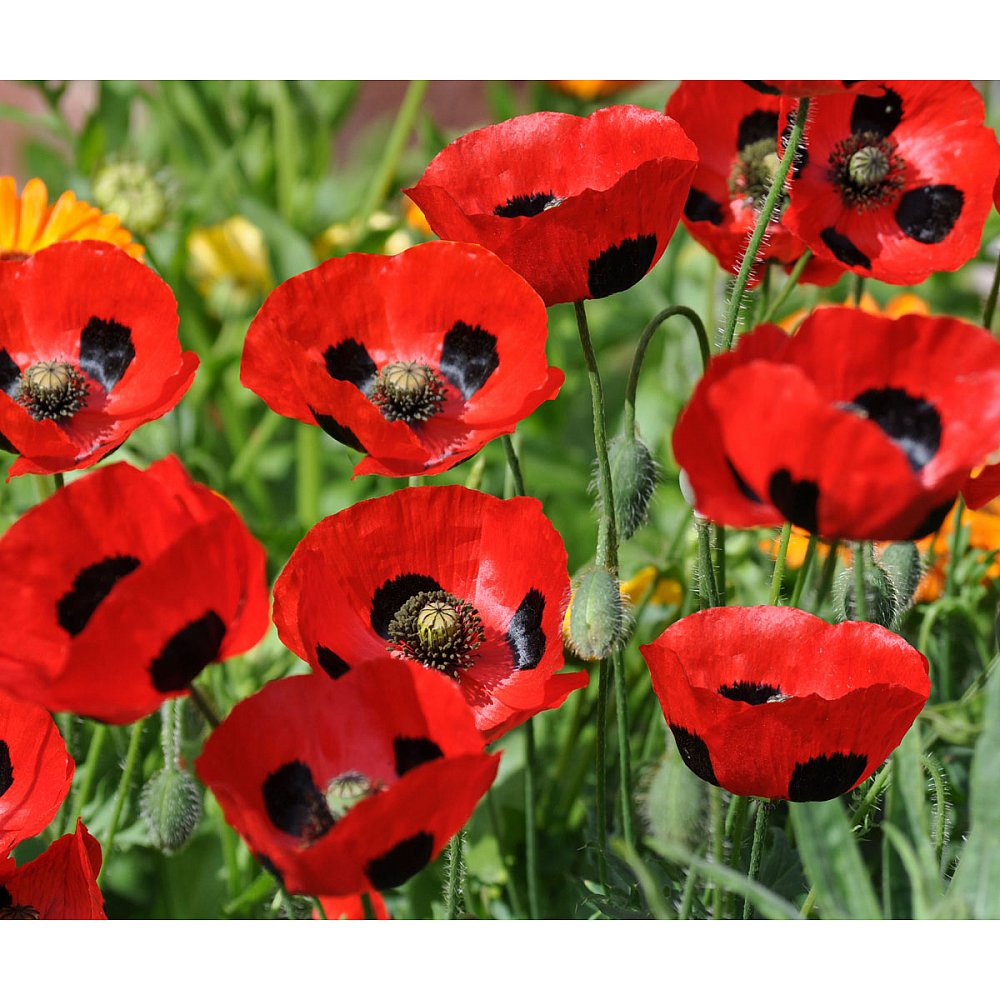
2. Papaver spp. (poppy)

Major active chemical: morphine (analgesic)
3. Echinopsis peruviana (Peruvian torch cactus)
Major active chemical: mescaline (psychedelic)
4. Nicotiana spp. (tobacco)
Major active chemical: nicotine (stimulant??)
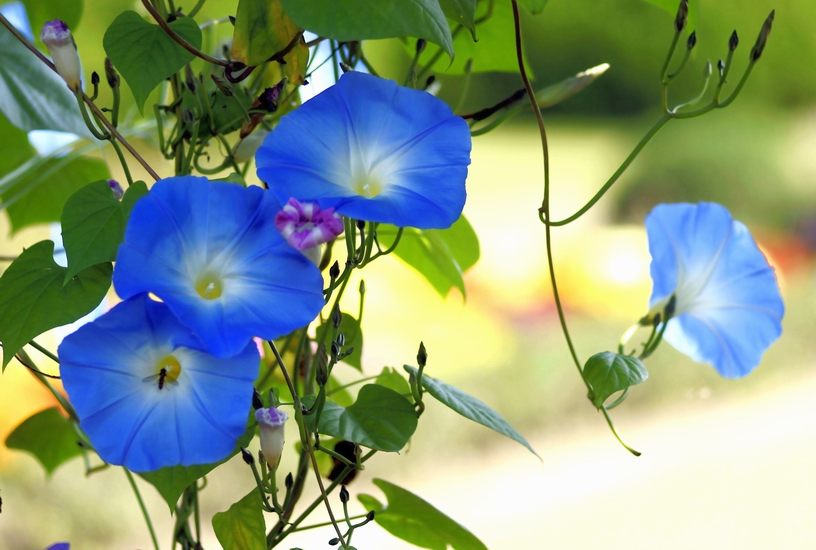
5. Ipomoea tricolor (morning glory)
Major active chemical: ergine (aka LSA, psychedelic)
6. Passiflora spp. (passion flower)
Major active chemicals: chrysin and other flavones (sedative), harman (MAOI)
7. Psychotria viridis
Major active chemical: DMT (psychedelic)
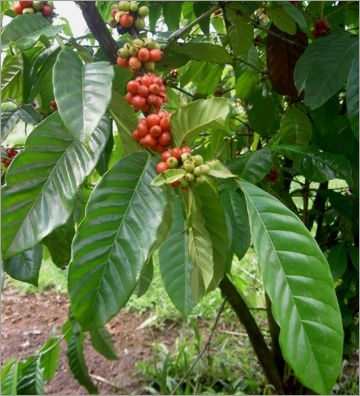
8. Coffea spp. (coffee tree)
Major active chemical: caffeine (stimulant)
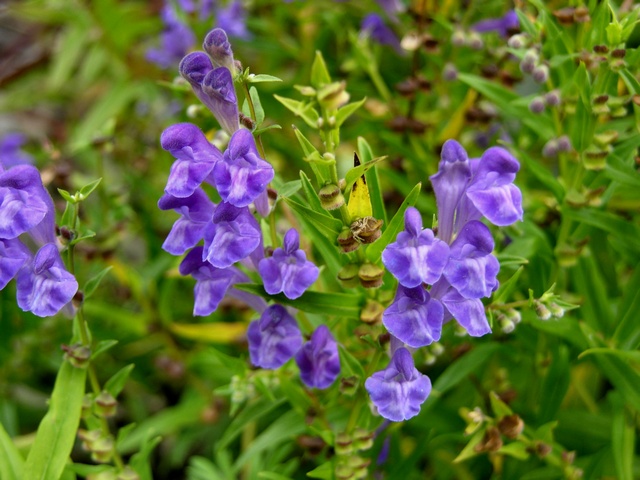
9. Scutellaria spp. (skullcap)
Major active chemicals: baicalein and other flavones (sedative)
1. Datura spp. (angel's trumpet; jimson weed)
Major active chemicals: atropine, scopolamine (anticholinergic deliriant)
2. Papaver spp. (poppy)
Major active chemical: morphine (analgesic)
3. Echinopsis peruviana (Peruvian torch cactus)
Major active chemical: mescaline (psychedelic)
4. Nicotiana spp. (tobacco)
Major active chemical: nicotine (stimulant??)
5. Ipomoea tricolor (morning glory)
Major active chemical: ergine (aka LSA, psychedelic)
6. Passiflora spp. (passion flower)
Major active chemicals: chrysin and other flavones (sedative), harman (MAOI)
7. Psychotria viridis
Major active chemical: DMT (psychedelic)
8. Coffea spp. (coffee tree)
Major active chemical: caffeine (stimulant)
9. Scutellaria spp. (skullcap)
Major active chemicals: baicalein and other flavones (sedative)
Saturday, June 8, 2013
兔子還敢吃嗎?
這是我以前留下來的和最近種的花:從一年級陪我到現在的和平百合,去年種的非洲菫、red prayer和lipstick plant,今年種的新幾內亞鳳仙、菊花、變葉草、香菜、和泰國辣椒。
希望這棵可以長大,開很多花,最好還結一些種子讓我留下來。還敢吃?毒死你,要不然就享受Datura有名的精神錯亂幻覺吧!
兔子不吃番茄樹,因為有微毒性。番茄苗本來好好的,最近快死了,不知是生病還是前一陣子天天下雨被淹死了?讓我心疼不已。家附近野兔、松鼠多,不停地破壞我的小花園。先是謀殺了常春藤,今天早上我又氣急敗壞地發現泰國辣椒半顆不見了。難道兔子不覺得辣嗎?和平百合、鳳仙、和其他的植物也不時慘遭毒手,這些鼠輩好像就算不吃,也喜歡把葉子啃幾口,拉扯到地上,或是亂挖盆栽裡的培養土。
我決定把菊花送給Madison Children's Museum,不然那一盆永遠都沒機會長大,一長葉子就被兔子吃掉。我今天去市場抱了一個曼陀羅花(Datura)回來。市場也有賣白花,這一個是淡紫花復辦,還有古怪的香味。跟台灣花是向下垂的品種不一樣,它的花是向上長的。希望這棵可以長大,開很多花,最好還結一些種子讓我留下來。還敢吃?毒死你,要不然就享受Datura有名的精神錯亂幻覺吧!
My First Scholarship
Me at the Undergraduate Award Ceremony (May 9, 2013) receiving my Hilldale Award (the first scholarship in my life), with the chancellor, Mr. David Ward. I received the scholarship for my research project on the Manduca juvenile hormone binding protein.
Me and my two friends from the Department of Entomology.
Saturday, June 1, 2013
The Two Assumptions of Heritability Studies
Evolution cannot occur without at least some traits being heritable. Heritability is a measure of parent-offspring resemblance; so a trait with high heritability has a high genetic component to it, right?
No.
This is one strange and paradoxical thing about heredity studies: heritability is defined as something specific to a certain population in certain circumstances. It is neither a property of an individual nor a property of a trait.
In parent-offspring correlation studies, heritability is simply the slope that measures the resemblance between the average trait value of the two parents and the trait value of the offspring. In twin studies, heritability is the correlation between the trait values of the twins.
From my reading about scientific and philosophical articles on heritability, I figured that two assumptions are implied in those studies without even being mentioned:
(1) Parents and offspring always resemble, instead of differ from, each other. (In other word, the slope of heritability on the parent-offspring graph is always positive.)
(2) Heritability can never equal to zero. This is because of how the math works out. Heritability is a correlation: a covariance over the product of two standard deviations. Covariances and standard deviations are always positive numbers.
Think about it: pick any measurable trait, its heritability will be a non-zero positive number, even if in reality it does not have genetic component. So what does heritability really tell us?
What would our evolution looks like if parents and offspring always tend to differ, not resemble, each other? Would we evolve backwards? Within one generation, the evolutionary response in the offspring will shift in the opposite direction as the selective pressure; however, the response will be cancelled in the grand-offspring generation under the same selective pressure. Just thinking about this weird scenario gave me a giggle fit in my philosophy-biology class.
No.
This is one strange and paradoxical thing about heredity studies: heritability is defined as something specific to a certain population in certain circumstances. It is neither a property of an individual nor a property of a trait.
In parent-offspring correlation studies, heritability is simply the slope that measures the resemblance between the average trait value of the two parents and the trait value of the offspring. In twin studies, heritability is the correlation between the trait values of the twins.
From my reading about scientific and philosophical articles on heritability, I figured that two assumptions are implied in those studies without even being mentioned:
(1) Parents and offspring always resemble, instead of differ from, each other. (In other word, the slope of heritability on the parent-offspring graph is always positive.)
(2) Heritability can never equal to zero. This is because of how the math works out. Heritability is a correlation: a covariance over the product of two standard deviations. Covariances and standard deviations are always positive numbers.
Think about it: pick any measurable trait, its heritability will be a non-zero positive number, even if in reality it does not have genetic component. So what does heritability really tell us?
What would our evolution looks like if parents and offspring always tend to differ, not resemble, each other? Would we evolve backwards? Within one generation, the evolutionary response in the offspring will shift in the opposite direction as the selective pressure; however, the response will be cancelled in the grand-offspring generation under the same selective pressure. Just thinking about this weird scenario gave me a giggle fit in my philosophy-biology class.
Labels:
biology,
evolution,
philosophy,
research,
school life,
writing
Tuesday, May 21, 2013
Dumpling Making (Chinese New Year)
I posted those photos on Facebook, but they could only be seemed by group members so I'm posting them here so other people can see them. Those are not all the photos, though.
February 16, 2013: Chinese New Year celebration - dumpling making with oSTEM
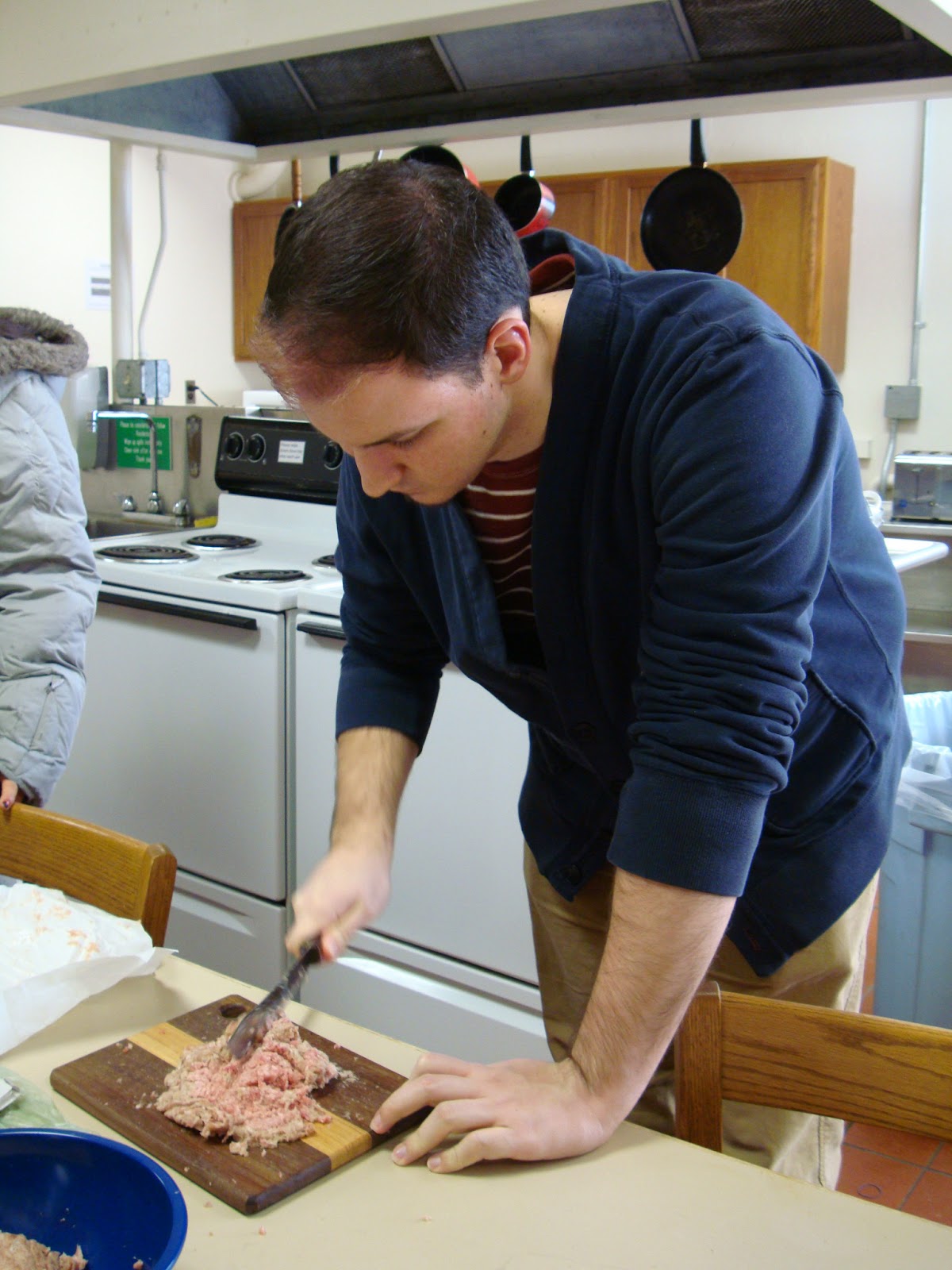
| It took a long time just to cut the pork and the cabbage. |
| We enjoyed it. One of the girls said, there is not a thing we added in the dumpling that I don't like. |
| I was so prepared in my Chinese shirt. I was teaching ancient Chinese secret! LOL |
| I think he really had fun chopping the pork. |
| Good arm exercise. :D |
| Why that expression? LOL |
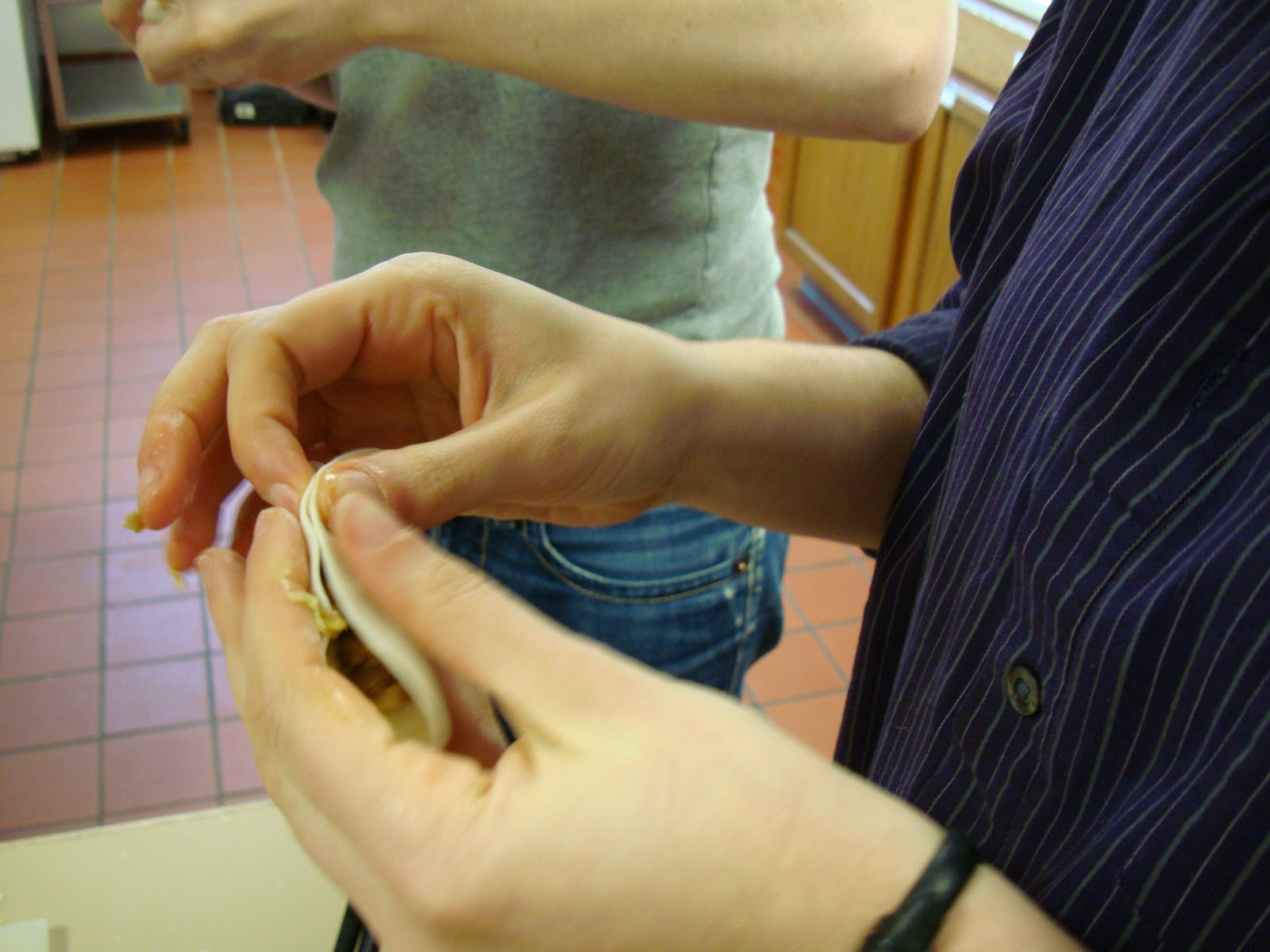
| My friends were amazing. We made about a hundred dumplings. It was their first time making dumplings, they learned it by just watching me once, and none of the dumplings broke after boiling. |
| "My mind just had a little imploding (when I saw how a dumpling is folded)," he said. |
| It was so delicious! I was so happy and proud! :D |
| I let them try different sauces. I had soy sauce, white vinegar, sesame oil, chili oil, and spicy bean sauce. They love it, even the spicy bean sauce. It must be a very different taste to them. |
| She was vegetarian, so she made a batch of vegetarian dumplings. |
| I think dumpling making is a great New Year tradition to carry on, isn't it? |
Thursday, April 4, 2013
Interview at Madison Children's Museum
The manager of the Rooftop of Madison Children's Museum interviewed me. She liked the fact that I love insects and I come from Taiwan. Interested in ethnobotany and indigenous agriculture, she hoped to hear about what vegetables and herbs Taiwanese people grow and eat. She also hoped that I could help take care of their cockroaches and meal-worms, and start a cricket culture; so the animals living on Rooftop will have food source, and children can look at those insects. I think it meant that she gladly accepted me as the summer volunteer, so I'll be going to Children's Museum one morning 9 to 1 o'clock per week to help take care of their garden, animals, and play with children!
Growing Food and Sustainability, after reviewing my application for their summer paid internship, said they were impressed by my application and wanted to interview me soon. I hope the interview will go well. I think one of the greatest things university taught me is bettering my BS ability. I wrote so much for the application but I already forgot what I wrote!
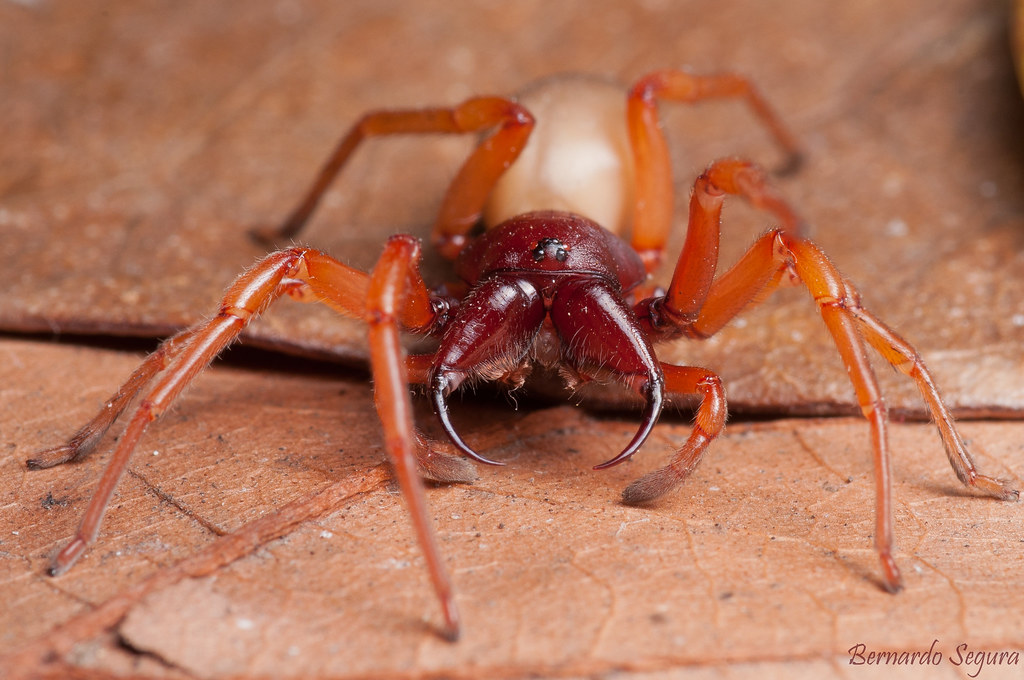
Dysdera crocata
I found a medium-sized spider in my house. At first, I was a bit alarmed because I didn't know if this red- and ivory-colored spider with big fangs was poisonous. I checked online and found it's a Dysdera crocata, commonly known as the woodlouse spider. It feeds exclusively on woodlice and its big fangs are used to grab and pierce through the exoskeleton of woodlice! Luckily this spider doesn't cause problems to humans. When I tried to find it again, it was gone, probably went hiding somewhere in my house. It was a pretty spider!
Pictures of spiders of the same species from the internet:
Thursday, March 14, 2013
Newspaper Banned My Comic and Audience's Reaction
After publishing two of my comic stripes, the Daily Cardinal, a
student-run newspaper, made a sudden decision that they could not
publish Molecules I Have Known and Loved. The release of MIHKAL
ended without receiving reader complaints or objection. Several people
expressed their disappointment or anger after hearing my apology that
MIHKAL was banned.
The Daily Cardinal staff said they were very concerned about depicting dangerous drugs, such as Speed, as cartoon characters. I was very excited to see my works published, but I understand that not all people can tolerate drug-related topics. My comical depiction can be easily interpreted by some people as advocacy for drugs. Here I'm saying again that the intention of my comic is neither promoting nor against recreational drugs. I'm more frustrated with the editors' inconsistency - granting me the opportunity then taking it away within a month.
Professor W. noted that there is always phobia of drugs in the society. He saw the outcome as discouraging but understandable. My lab professor did not see a good potential in MIHKAL as a comic series, but said it surprised him that the Daily Cardinal, well-known on campus for their liberal and undaunting attitude, turned it away.
Other people deemed the newspaper editors' decision as narrow-minded. They understood that MIHKAL is meant to be a humorous take-on of the subject. My current classmate S. K. thought newspapers should publish controversial materials to promote the diversity and freedom of expression. A post doc in philosophy and a physics faculty said it was "ridiculous", because Speed whom was blamed is just a comic character. People who do drugs would have done them anyways, regardless if they read my comic. The faculty said with disbelief that the Daily Cardinal, which publishes offensive and controversial things all the time, including articles that teach people how to have sex, would reject such funny and artistic work.
Some faculties felt sorry for losing an opportunity to educate the public. C. D., a research fellow specialized in sedative-hypnotics, wrote in a message that "they clearly did not get the scope of [the] comic" and that people just can't make rational judgement on certain topics. The physics faculty imagined MIHKAL would be very informative, which could potentially help reduce drug-related problems in the society. "The problem is we don't talk about it," she said.
A few people thought the newspaper should never publish such material. Perhaps with some misunderstanding, Professor G. said, not unhappily, "[The comic] suggests that you [the author] took and enjoyed those drugs. I was surprised that the newspaper agreed to publish it."
Despite people's divergent opinions, they agreed that the quality of my art is good. I've got a feeling that this is not the end of this incident. The Daily Cardinal staff said they still hoped my art to be a part of their paper and wanted to discuss with me, though with hesitation and possibly denial. Two of my friends eagerly wanted to see MIHKAL published on paper and volunteered to show my online samples to the city-based newspaper office.
So far I'm happy with just doing a web-based comic series and sharing it with my dear friends and professors. It should be a work enjoyed by people who do drugs as well as people who don't. In fact, I've received positive responses from both kinds of people. I'm also getting prepared to be notorious if I'm determined to deal with this subject in long-term. This is definitely not the end of MIHKAL. It just got started.
The Daily Cardinal staff said they were very concerned about depicting dangerous drugs, such as Speed, as cartoon characters. I was very excited to see my works published, but I understand that not all people can tolerate drug-related topics. My comical depiction can be easily interpreted by some people as advocacy for drugs. Here I'm saying again that the intention of my comic is neither promoting nor against recreational drugs. I'm more frustrated with the editors' inconsistency - granting me the opportunity then taking it away within a month.
Professor W. noted that there is always phobia of drugs in the society. He saw the outcome as discouraging but understandable. My lab professor did not see a good potential in MIHKAL as a comic series, but said it surprised him that the Daily Cardinal, well-known on campus for their liberal and undaunting attitude, turned it away.
Other people deemed the newspaper editors' decision as narrow-minded. They understood that MIHKAL is meant to be a humorous take-on of the subject. My current classmate S. K. thought newspapers should publish controversial materials to promote the diversity and freedom of expression. A post doc in philosophy and a physics faculty said it was "ridiculous", because Speed whom was blamed is just a comic character. People who do drugs would have done them anyways, regardless if they read my comic. The faculty said with disbelief that the Daily Cardinal, which publishes offensive and controversial things all the time, including articles that teach people how to have sex, would reject such funny and artistic work.
Some faculties felt sorry for losing an opportunity to educate the public. C. D., a research fellow specialized in sedative-hypnotics, wrote in a message that "they clearly did not get the scope of [the] comic" and that people just can't make rational judgement on certain topics. The physics faculty imagined MIHKAL would be very informative, which could potentially help reduce drug-related problems in the society. "The problem is we don't talk about it," she said.
A few people thought the newspaper should never publish such material. Perhaps with some misunderstanding, Professor G. said, not unhappily, "[The comic] suggests that you [the author] took and enjoyed those drugs. I was surprised that the newspaper agreed to publish it."
Despite people's divergent opinions, they agreed that the quality of my art is good. I've got a feeling that this is not the end of this incident. The Daily Cardinal staff said they still hoped my art to be a part of their paper and wanted to discuss with me, though with hesitation and possibly denial. Two of my friends eagerly wanted to see MIHKAL published on paper and volunteered to show my online samples to the city-based newspaper office.
So far I'm happy with just doing a web-based comic series and sharing it with my dear friends and professors. It should be a work enjoyed by people who do drugs as well as people who don't. In fact, I've received positive responses from both kinds of people. I'm also getting prepared to be notorious if I'm determined to deal with this subject in long-term. This is definitely not the end of MIHKAL. It just got started.
Labels:
chemistry,
comic,
MIHKAL,
news,
newspaper,
psychedelic,
school life,
writing
Subscribe to:
Comments (Atom)